PHYSICAL INTERVENTION TRAINING (BILD-ACT CERTIFIED)
CORPORATE TRAINING
MANDATORY TRAINING
CLINICAL SKILL TRAINING
OTHER HEALTHCARE COURSES
COMPANY INFO
- Course Calendar
- Reviews
- Video & Gallery
- Terms & Conditions
- Healthcare News & Blog
- Contact Us
E-Learning for healthcare


Venepuncture (Phlebotomy) and Cannulation Training
£150 Only
Why Choose Our Phlebotomy and Cannulation Training in Manchester
We provide phlebotomy and cannulation training in Manchester, serving learners across Greater Manchester including Salford, Stockport, Bolton, and surrounding areas. Our venepuncture course is ideal for anyone looking to start or advance a healthcare career in the UK.
Venepuncture (Phlebotomy) and Cannulation are among the most commonly performed procedures in the healthcare sector. To carry out these procedures safely and effectively, practitioners must have relevant and up-to-date knowledge and skills.
This comprehensive 8-hour training programme in Manchester provides participants with both the theoretical knowledge and practical skills required to perform safe and effective venepuncture and cannulation. The course emphasises anatomy, infection control, patient communication, and hands-on practice using simulation equipment.
This beginner-friendly phlebotomy course in Manchester is also suitable as a refresher for experienced healthcare professionals looking to update their skills.
Phlebotomy Training in Manchester
Our phlebotomy training in Manchester is designed for individuals looking to gain practical, hands-on experience in blood collection and venepuncture. Located in Manchester, our training centre is easily accessible from surrounding areas including Salford, Bolton, Stockport, Oldham, and Greater Manchester.
What is Phlebotomy?
Phlebotomy is the critical clinical process of drawing blood from patients for medical testing, transfusions, research, or blood donations. As an essential skillset across the UK healthcare sector, a professionally trained phlebotomist guarantees sterile blood collection protocols, accurate sample preservation management, and compassionate patient care.
Who Should Take This Course?
This professional classroom training module in Manchester is customized for:
- ✔ Healthcare Assistants (HCAs) and clinical support teams
- ✔ Nursing students and newly qualified nurses updating credentials
- ✔ Individuals migrating into clinical healthcare employment
- ✔ Care professionals requiring advanced venepuncture verification
Career Opportunities After Training
Secure immediate clinical placements across diverse medical environments:
- 📍 NHS Hospitals and regional clinical trust centers
- 📍 Private medical clinics and diagnostic pathology laboratories
- 📍 Local GP surgeries and community wellness centers
- 📍 Permanent placement nursing agencies and blood donor banks
Practical Simulation Training Details
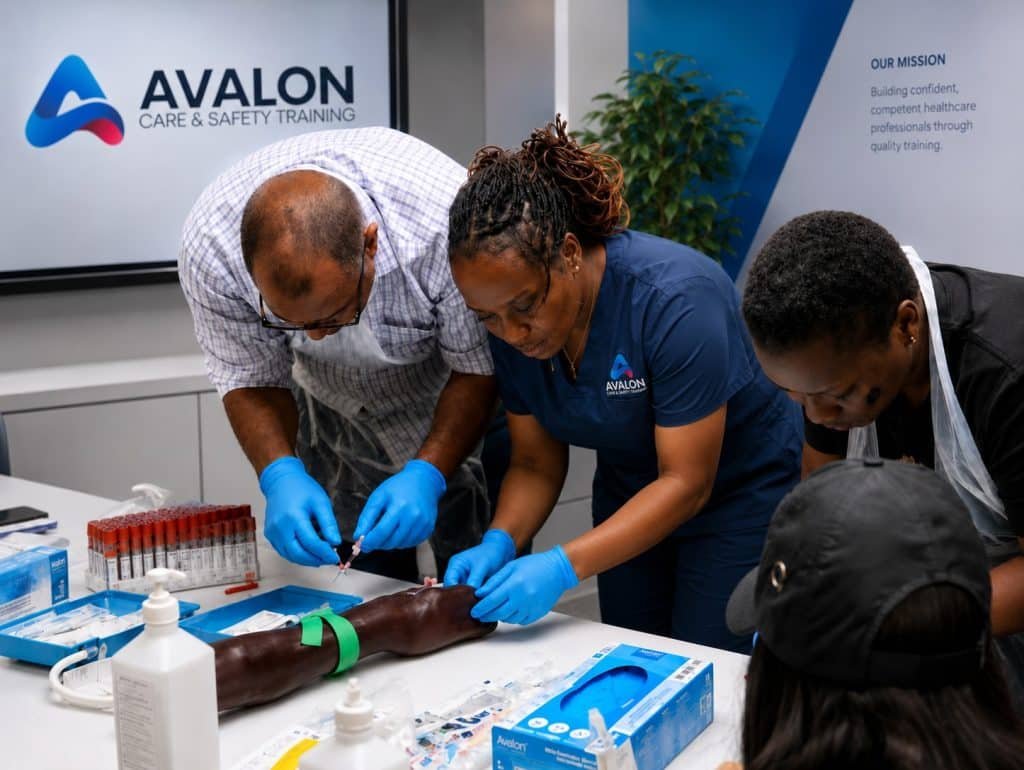
Our structured class configuration provides intensive, hands-on clinical drill modules. Under expert trainer oversight, participants practice venepuncture mechanics utilizing synthetic simulation arms, learning safe needle-gauge handling, strict infection containment control, cross-contamination prevention, and optimal patient vein site evaluation.
Certification & Professional Accreditation
Upon verification of performance competency, delegates receive an official CPD certification demonstrating clinical phlebotomy and venepuncture compliance. This physical credential aligns with UK educational standards, validating your capabilities to compliance inspectors and recruitment managers.
Average UK Phlebotomist Salary Trends
Qualified professionals in the United Kingdom typically secure standard compensation ranges between £20,000 and £30,000 per annum. Entry points scale relative to local shift hours, with advanced clinical positions or flexible regional agency contracting structures offering higher diagnostic hourly parameters.
Frequently Asked Questions
Do you offer face-to-face Phlebotomy and Cannulation training at your Manchester hub?
Yes! We run regular 1-day intensive Phlebotomy and Cannulation courses right here at Unit 16, Cariocca Business Park, Sawley Road, Manchester (M40 8BB). The training includes hands-on practice with clinical simulation equipment and same-day certificate processing.
How much does the Phlebotomy course in Manchester cost and how do I book?
Our 1-day Manchester Phlebotomy & Cannulation training costs £150 with no hidden fees. This price includes all clinical theory materials, hands-on simulation drills, and your physical certificate. You can book online or call us directly at 020 3955 8295.
Can beginners join this phlebotomy training, or do you need prior experience?
Our course is fully beginner-friendly! It is perfectly tailored for Healthcare Assistants (HCAs), support workers, aspiring phlebotomists, and nurses wanting a refresher. We use specialized simulation arms to help everyone learn to access veins confidently.
Is the Phlebotomy and Cannulation certificate issued at Manchester accredited?
Yes, our course provides a fully accredited CPD certificate mapped directly to statutory UK healthcare frameworks. Your certificate is processed and issued on the exact same day as your training session, and it remains valid for 1 full year.
What days do you run training and do you offer private group bookings?
We host open classroom training sessions throughout the week at our Manchester hub. We also specialize in private, bespoke group bookings for healthcare agencies and care homes, which can be delivered at our center or on-site at your facility.
Face-to-Face Theory & Practical Training
Gain clinical foundations to access veins confidently using simulation equipment. Our small class group sizes allow for dedicated, one-to-one support during the practical sessions, ensuring every participant receives personalized guidance from expert clinical trainers.
By the end of this course, you will understand:
- ✔ The legal aspects of Venepuncture and Cannulation.
- ✔ Venous anatomy and physiology relevant to clinical site selection.
- ✔ Application of infection prevention, control measures, and ANTT processes.
- ✔ Patient and environmental risk factors affecting the procedure.
- ✔ The needle gauge system, equipment parameters, and selection guidelines.
- ✔ Step-by-step techniques to perform Venepuncture and Cannulation safely.
- ✔ Common complications, adverse effects, and localized clinical management.
- ✔ Correct medical documentation protocols and specimen tube labeling.
- ✔ Strategies for maintaining long-term workplace clinical competence.
Hands-On Practical Session
- Expert trainer physical demonstration.
- Supervised candidate practical learning drills.
- Individual candidate competency assessment.
Course Benefits
Certificate Awarded Same-Day
Valid for 1 year from the course date.
Our Manchester Training Center
📍 Address:
Unit 16, Cariocca Business Park, 2 Sawley Road, Miles Platting, Manchester, M40 8BB.
🚗 Parking: Free, secure on-site student parking is available within the main business park gates.
🚊 Transit: Served cleanly by major regional bus corridors and nearby train line links.
☕
Complimentary TEA AND COFFEE PROVIDED during sessions.
Located within the central Miles Platting business hub to serve local healthcare candidates effortlessly.
Book Your Phlebotomy Training in Manchester
All learners will also be subject to an assessment of physical skills carried out by the lead trainer
Trusted by Professionals
Google Rating
£150
Save 20% compared to other providers
Price starts at £150 per person
- 1 day Intensive (9am - 5pm)
- Holds in Manchester
- Highly-Rated Training